MARCH 16, 2015

The Bride and Her Suitors

A funny thing happened when I went back to the dressmaker’s dummy and some my objects after a day or so away. As i said, I’m not really a still life guy so my approach to it is something I am discovering as I go, and the strangest ideas pop into my head as I study the things arrayed on the set. While I was moving these objects around – and I wish I could figure out how to make a little flip book of the moves to share with you –  because it’s interesting to watch the objects seem to move, like a stop motion film capturing all the little, incremental, steps they take. In a way it’s like animation, really.

While I was moving the pieces a thought floated up from nowhere, which was; these pieces around the dummy feel like ‘suitors’ in a fairy tale, and the dummy was the “Bride”. Now where did that come from? But as soon as it came to me I could no longer put it back in its box, and so my process kept on entertaining that notion and storyline. As I moved each object into the “suitors” stance each of them seemed to have a particular attitude; shy, bold, deferential, arrogant, stupid, clumsy, etc. I felt a little like a Disney animator casting my characters by their shapes and size, and then attributing other qualities to them. And the game became so entrancing that time just flew by.

Finally, the least of them all – the rusted and deformed exhaust pipe from a tractor – which I found in a field, came to bow before the Bride, and there it was! I had a feeling, what else can I call it! It seemed to fulfill those old Grimm’s Fairy Tale stories where the poor cobbler’s son presents himself before the royals and wins the day with his humility, or bravery, or other characteristics that show the other suitors to be the phonies they are.

Now where this came from I have no idea. But I went with it, and trusted that I was meant to see it this way.

03-16 L1000820

MARCH 15, 2015

Sweep

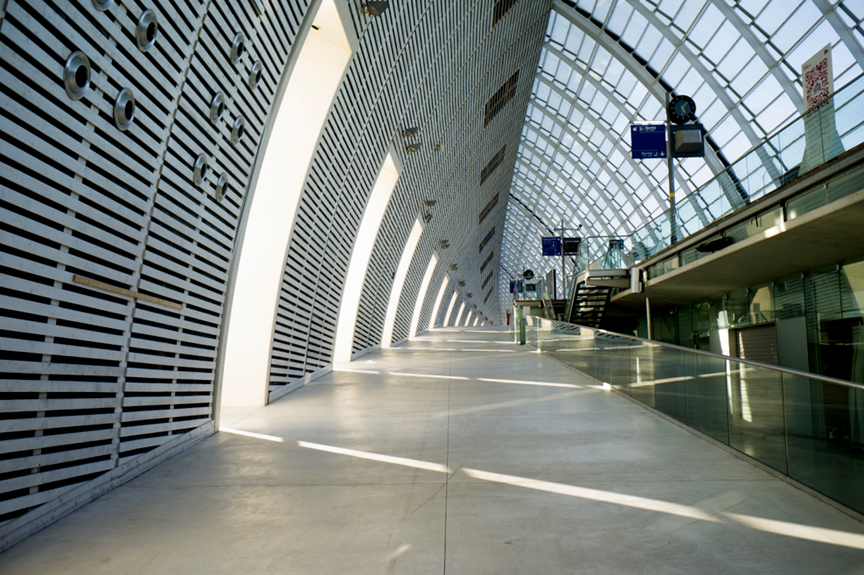
Public spaces are interesting because we occupy them, often briefly or in passing, as consumers of their services; train stations, music halls, post offices, museums, and other places that function as a backdrop to our immediate needs. Many of these places don’t have the sweep and style today that they once were graced with in the era when grandeur was what cities or nations wanted to express about themselves. Not that there aren’t wonderful places still being built, but more often than not they are jammed with advertising and are made with a cost cutting and bottom line mentality.

So when I went to the TGV station in Avignon, on my way to Paris, I was taken in by the thoughtful design and simplicity of form of the engineering, and the way the light filled place made me feel. it seemed to me to be a pure expression of speed, and and speed is what the TGV is all about, And as I walked up the concourse ramp, not fast, but languidly, taking my time, I marked my admiration with photographs along the way.

03-15 L1026757

MARCH 14, 2015

The Dummy

At a flea market I found this dressmaker’s dummy, probably something from the 1950’s, and to my surprise I found myself wanting if for the still lives I was beginning to make. In fact at first I had a strong pull toward it, then walked away thinking, ‘this is crazy, Joel, what do you want that for’? What was it about the dummy? Why was it so strangely appealing to me? In my life as a photographer, making table top still life work was never something that called to me. Give me the street any day with its unpredictability, chaos, radical light conditions, and the joys of timing, which always made me concentrate more fiercely.

Yet, there I was, going back to the stall and standing in front of this mysterious figure again and wanting to take it home to see how it played with the other objects that were finding their way into my life. How can I explain it? Maybe it was a Magritte-like mystery that presented itself, or another echo coming to me from the Dadaists and Surrealists, who I loved when I was an art student nearly 60 years ago. Whatever it was it was strong enough to make me say yes to it and leave the rest to chance. That part is like the street which is all about chance.

On this day I put it up on the ‘teatrino’, my little theater-like set, and added some other objects that also have found their way to me, just to see what would happen in terms of scale, color, the various forms, and whatever meaning might emerge from their encounter. I have no answer as yet, just some ‘records’ of what things look like. Now it is time to look and wonder.

03-14 L1000806

MARCH 13, 2015

Glorious Monster

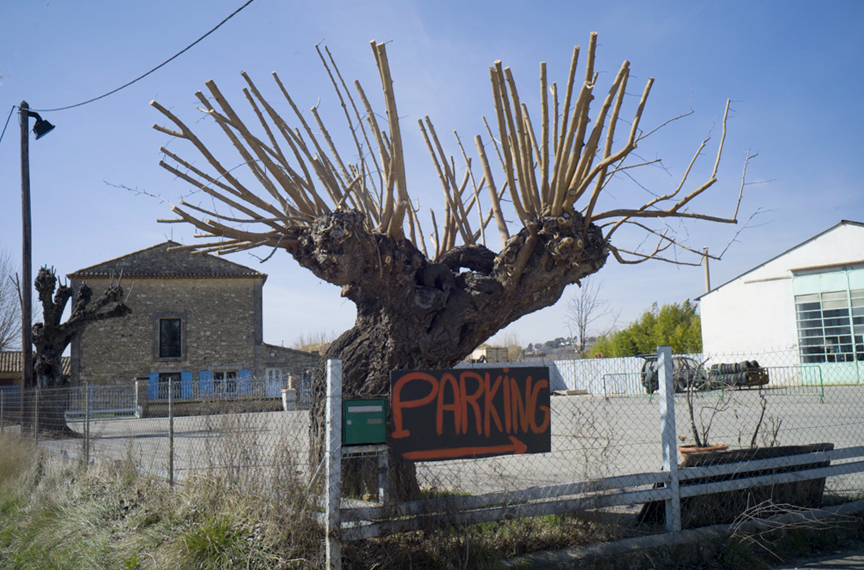
The French are brutal pruners of their trees in springtime. Not that I know much about the methods of pruners and what is right or not, although I am sure they are right since the trees live long and look healthy and produce well. This glorious monster had caught my eye countless times as I drove past, making my head snap to attention to catch a glimpse of its wild crown of thorns as I whizzed past.

On this day I had to stop. The tree had been given a Mohawk that really was fantastic to look at. I parked at roadside and waltzed around it for the 10 minutes or so it took to try and see where the image was at its best; where it sang its song, danced its dance, came into focus as an image as well as being just the tree itself. These exercises in limited situations (I couldn’t get behind it as the gate was locked) are fun to experience because they test one’s patience, inventiveness, and character.

Here it stands in all its grandeur, yet humiliated by the crappy sign, fence, and surroundings. I gave it all my attention but couldn’t rescue it from its fate.

03-13 L1026733

MARCH 12, 2015

Monuments

Years ago when I was on a Guggenheim Fellowship grant I  toured America looking at the way Americans were living while we were in the middle of the Vietnam war. I was also interested in the way we were spending our leisure time, and how the culture was reflected in our monuments and tourist attractions, and I was curious about a lot of other attitudes of that period.

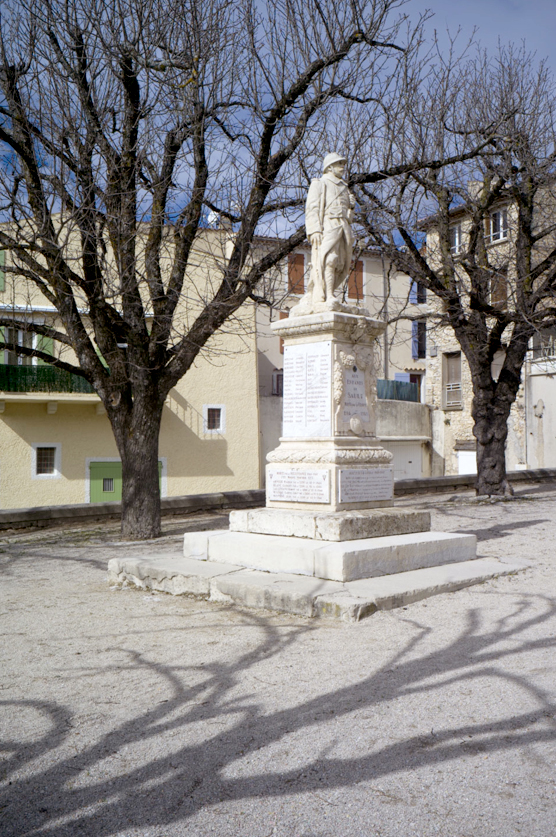
One of the things i noticed was that a lot of our military junk was finding its way into playgrounds, civic spaces, and intersections on highways, to name a few places. Old fighter jets, and missile launchers, armored cars and tanks, the rusting leftovers of the military-industrail complex that Eisenhower warned us against. What I seldom saw was the kind of memorial that The Great Wars of the 20th century produced, those valiant figures helping a fallen comrade, or standing firm against the onslaught, or looking toward the future with some degree of resilience and hope.

When I see these European monuments in small towns all over France I feel the tenderness that those losses addressed. Millions of young men were slaughtered by the incompetence of their war making leaders and the politics of their era. I find it hard to pass these empty plazas and not stop for a moment to read some names, take into account the ages of the dead, be surprised at how many were killed from some of these tiny villages.

On a day when the winter is giving up its bitter edge, human folly still shows its tragic face.

03-12-L1026720

MARCH 11, 2015

Playmates

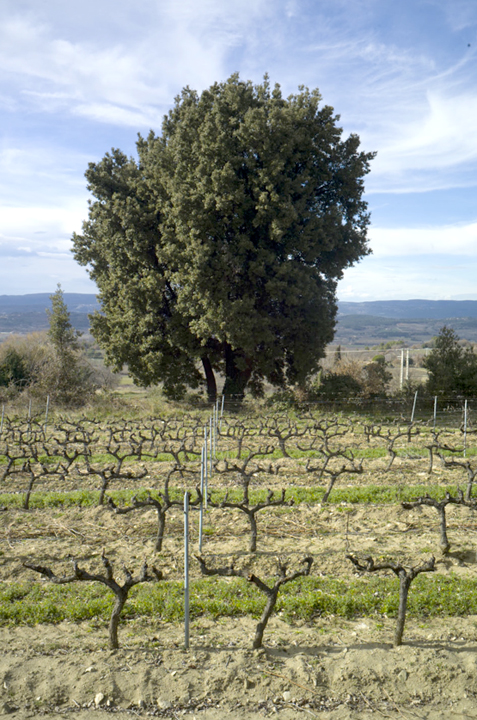
It was one of those spring days where everything seemed to be popping. Radiant greens along sun-warmed banks and walls, tiny buds pushing out of branch ends, grape vines beginning to look like miniature candelabras, a joyous day where I was aware of trees in a way that winter made me forget. When I stop to look at each tree individually their complexity and magnitude become astonishing, even trees that at first don’t seem to be worth the look, but then grab my attention because of where they are growing and what trials they had to overcome to survive.

I have probably photographed hundreds of trees in my life as a photographer, and none of them are just a ‘generic’ tree to me. They seem to me to be more like portraits of creatures who are extravagant in their proportions, structure, overall form, and, in season, their foliage. None of them are asking to be seen or photographed, but when I stand in their space I often get their message.

Here are some trees I encountered along the way, and what they suggested I do if I wanted to play with them, or watch as Maggie did.

03-11 L1026689

03-11 L1026684

03-11 L1026706

Maggie 4 trees

MARCH 10, 2015

Time Machine

The camera is a time machine. It measures time in fractions of a second. It shows us the time of day. It describes the seasons. It reflects what kind of time we are having, if you look hard enough you might be able to see something of what the photographer was feeling, but that is open to discussion I am sure.

A photograph of a wall like this one tells me a lot. It’s not just about the colors – which are delicious – or the time of day it was made, but when I stood there what I saw was the passage of time etched into the life of the wall. The layers of color applied over different times of the building’s life. The wearing down of the colors and the walls themselves. The addition of a window, or a doorway, the closing up again, and other, invisible forces, too. For example; those arcs on the wall, how did they get there? They must have been from vines that grew over the wall and were strong enough to score the surface as the wind tossed them around, and like a protractor they left their geometry scraped into the wall.

03-10 L1026672

Time is told in this image by the sense of the freshening of the light. A spring urgency is just becoming visible in the newness of the grasses and in the silver glitter of the olive trees. Time is present to me in the way I feel on a day like this, when I wonder, ‘how many more Springs will I see?’

03-10 L1026658


MARCH 9, 2015

State of Play

Sometimes the liveliest things on the street, especially in a small town in Provence where no one ever seems to be around, are the vestiges of inanimate things that suddenly appear. My way of working is to respond to whatever comes up for me out of my passage through time and space. It could be nearly meaningless, ordinary, dumb, or unlikely to be of greater interest later on, it doesn’t matter, it is the only thing that is speaking to me at that given instant, and that is what I have to work with.

Anything that makes me pay attention, even for just a moment, is one more moment of consciousness, and once again a trickle of playful energy occupies my mind. It is this willingness to make something of nothing that primes my senses for whatever may follow that moment. I find that if I do not play when something calls to me then I lose my edge, soI let myself be taken in, and I play. And by doing so my innocence is capable of being prompted by the unexpected when it next shows up.

And we know that as we get older the innocent joy of discovery gets whittled away by all the other responsibilities that life throws at us, which distracts us from that state of play. So a moment of open ended curiosity, and the freedom to see in a care less way, is a gift we must not turn away from.

03-9 L1026566

MARCH 8, 2015

The Diversity of the Moment

When I come across plain geometries in nature, like this simple square with a roof, a certain  pleasure arises immediately. How did the maker know to do it this way? Is tradition the simple form that drove the decision? Did whoever built it have an innate sense of Feng Shui? Was it the practical needs of farming and family that created this particular form for this particular house?

Whatever it was it is an undeniable gift to see Euclidean shapes amidst the rampant energies of nature. It makes me consider both the man made and the wild in a fresh way. And of course the light at this time of year has a new intensity as the earth once again tilts on its axis to lengthen the days and add warmth to the light.

I photographed this place by moving the square around in the frame, left, right, lower and higher horizon line, centered, then vertically, and so on. But when it came right down to it, keeping it centered had a logic as clear as the geometry itself. And 35mm, too, has its own beautiful dynamic of 2 to 3, or what Henri Cartier-Bresson referred to as the ‘golden mean.’ Which I imagine most of the world’s photographers work with since that is the basic format of  cameras today.

In that sense we all are working with the same essential vocabulary, and yet the diversity is amazing between how each of us might see the scene. I remember many times in workshops I have taught, seeing how 2 photographers standing nearly side by side, photographing the same space or event, have come away with such different results as to make it seem as if  they came to the place at different times. Photography holds the diversity of the moment.

03-8 L1026558

MARCH 7, 2015

Like This

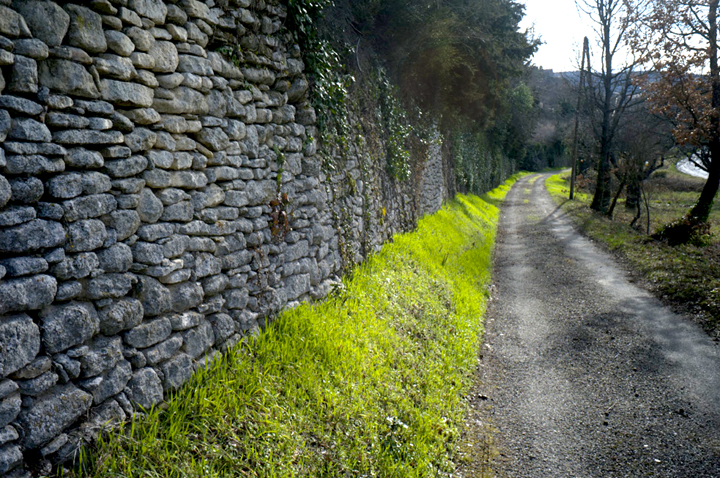
Before cars and people came down this street, before roads and houses were built, before walls were mounded up for defense or boundaries, the stones themselves felt water rushing past. I never cease to wonder when I stop here, about the marks grooved into the stone, and how many millennia of rising and falling waters have passed since this was part of the sea bottom or shoreline of what is now the Mediterranean Sea.

The courses of stones and the courses of the smoothed ridges blend together in a stony harmony that delights my eye, and I always seem to find a reason to lift my camera and try to make a photograph that describes what it is I see. This image, made at the end of day, when the light was flat and had the faintest lavender cast to it, may (or may not) work, because it doesn’t depend on the glory of sunlight, or the drama of some action, to set off the place from the rather ordinary seeming place that it is. It is just its unmediated self now.

It’s the rocks that first produce the ‘beat’ that means something to me and makes me stop, so I need to reconsider what it is I want to say about them. Fortunately I had time here to look again and again, since I walked this way every few days. It’s a little like solving a math problem in one’s head, and by going over it again and again the meaning may resolve itself.

Once, when I was around 15, I saw Albert Einstein walking the back streets of Princeton, while I was on a day trip there from summer camp, and had slipped away from my group. He was on a back street; tree lined, quiet, nothing to mark it as special from the next one, and as I watched him from a hundred yards away, he stopped and stood for a long time doing nothing, head tilted slightly up, possibly watching the leaves trembling, or listening to the birds. Perhaps he was following a line of reasoning that was out there in the universe of his mind’s embrace. Of course it was impossible to imagine then, as it is now, what anyone else thinks about, but standing still, and taking it all in, like Einstein, is part of the photographic act at certain moments. And certain moments are what photographs are made of.

Like this one.

03-7 L1026540