Tag Archives: Still Life

FEBRUARY 15, 2015

Time As Light

When I began making these new still life photographs, in the year before this image below, I found myself working in a dark environment which was a strange thing for me to do since ‘Light’ was the phenomena that marked my photographs as mine. So why the dark? What was so attractive about that? These thoughts, and many more, are questions that rise up out of the chance events of our lives when combined with our creative impulses.

To tell the truth though, it was the weather! That summer the temperature in Tuscany was over 95 every day for 3 months – it never rained – and so searing was it that during the middle of the day it was impossible to be outside, so I retreated into the little studio that Maggie and I shared on the farm we had rented. The studio has never been my normal habitat.

Confronted with a dark corner there, darker than this one in the photograph from Bonnieux, I made many studies on different backgrounds, and over 2 to 3 weeks of work I finally arrived at this dark cloth as my sfondo (background). In fact I took this 100 year old piece of stained linen and had it printed with a dark tone I made out of a number of reassembled photographs of mine so that i had just what I needed to place my growing collection of dark objects on.

There is a story that perhaps some of you know, but which I heard from Ben Maddow, a friend of Edward Weston’s, when he was writing a book about him back in the 70’s. He told me that the famous image of The Pepper was made by placing it inside an old tin funnel (if you look closely you will see the curves of the funnel below the pepper) and that Weston put it far back in his studio away from the light in front. And that he told his sons, Brett and Cole, not to run around since the exposure was to be a long one and he didn’t want the floor to shake. Then he made an exposure (the stories vary from 6 minutes to many hours), letting the slow accretion of photons come to caress and build the light on the dark pepper set inside the dark funnel, in that dark corner of the studio.

This story always pleased me, and because I’ve used an 8×10 view camera since 1976, and know very well the generosity of the light, especially when time is used as light,  I appreciated the strategy, and decided to adopt it to my new work. It has taught me more than I can say here, but perhaps as this blog continues, and these images appear, I’ll carry this inquiry further along.

Feb-15 L1026160

JANUARY 31, 2015

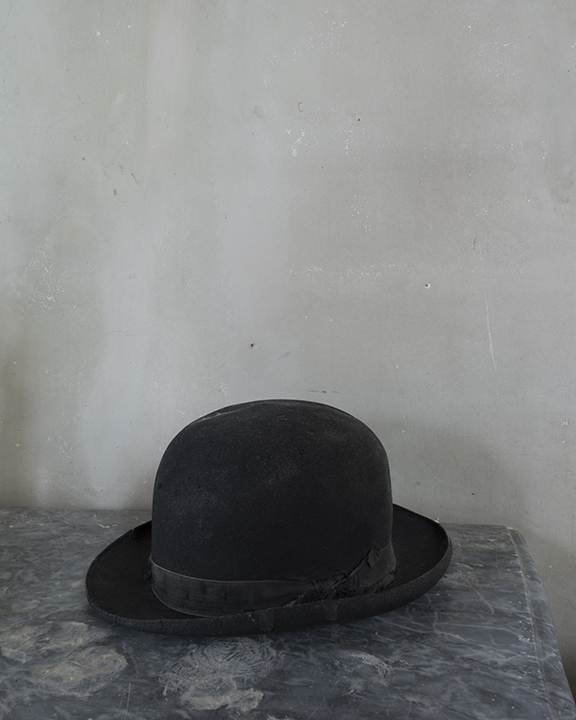
Cezanne’s Hat

I walked into Cezanne’s studio in Aix-en-Provence and stood in awe of the space that he created for himself back in the 1890’s. Cezanne, I have always been in awe of. But to be in the real place, not some museum dramatization of his space, as is often the case these days, was to be in touch with whatever there was left of his spirit. And for me it appeared in the form of the grey color on the walls.

Why grey?, especially with all that light (or maybe because of it?). Today almost every studio is white walled, like a museum white box exhibition space. So the grey fascinated me, and a number of other thoughts rose up about what grey did for him in his search for the flatness of paint on canvas as opposed to the illusion of deep space and perspective. He was giving all that up and it is why he is considered the father of modern painting, because to break with that long tradition of Renaissance perspective, in favor of marks on canvas, was a huge leap into the 20th century.

On the shelves above his painting table I noticed many of the objects that I have seen in his paintings, I asked the director if I could take them down and look at them against the grey wall and then to photograph them, in an effort to better understand his reasons for the grey. She told me no photographs were allowed, so I gently pushed her to check me out on the web and see my seriousness of purpose. Surprise! She let me have my way with the objects. Now, after 3 visits there, I have photographed more than 70 of his bottles, coffee pots, ink wells, cans, pitchers, cups, basins, decanters, wooden models, and assorted rubbish found in some of the drawers.

Out of this study I have begun making still life grids with as many as 25 images in the grid. More about this another time, but for the moment we can look at Cezanne’s Hat. Which, when I put it on, came down over my ears! He must have had a huge head!

Jan-31 L1000569

Jan-31 L1000560

Jan-31 L1000545

JANUARY 12, 2015

This Is Not A Pipe….”Ceci n’est pas une pipe“, Magritte

I came across this pipe (which?). It was lying innocently on it’s side among a lot of other lost souls in a stall filled with castoffs of all description. So why, as I passed by, did this unnecessary object call out to me,  a call which I barely heard amidst the din of all the glittering and shapely spent objects? It was a pipe. And I heard that long remembered Magritte line;”Ceci n’est pas une pipe“. But it was.

When I saw it in my own collection it fell in with this brass and copper pipe, something that once might have been in the mouth of a fish, or a face on a fountain. One pipe weighs nearly nothing and is silk in the hand, while the other has gravity and weight, and is cold to the touch though warm to the eye. They seemed to want to be together. That suggestion coming to me was so timid as to be just below consciousness, but I heard it, the Zen Bell I always hear when it calls me. I’ve learned to listen for it.

On the hand made background (more about that some other time) they came to life and played together, and something like a force shivered between them, and they continued to fall against each other until I found their balance and poise. The cloth added a note as well. I was in thrall to the light, and the dark, and the way their character, independent of each other, and together, emerged.

I was taken in.

Jan-12 L1000293

JANUARY 10, 2015

Getting to Know Them

I found myself collecting strange cast offs in the local flea markets recently. I’ve never been much of a collector of objects. Having so many thousands of photographs, stacked nearly floor to ceiling high on the shelves of my studio, I always thought I had enough ‘things’ already. But these old odd forms that call out to me are suggesting themselves as worthy objects to consider in some sort of still life way, still lives being something that never really were part of my vocabulary as a photographer until last year when the urge first came to me.

Since then I periodically find myself simply staring at some of these objects and turning them slowly around so that each new aspect of their form reveals another possible shift in my first or overall impression. It is as if their truest expression of their ‘objectness’, their ‘personality’, suggests that I stop and look harder – which is what I think photography is really all about – looking harder at what we may think we already know – and by doing that I get glimpses of their hidden sweet spot, and once you know where that is you want to explore it.

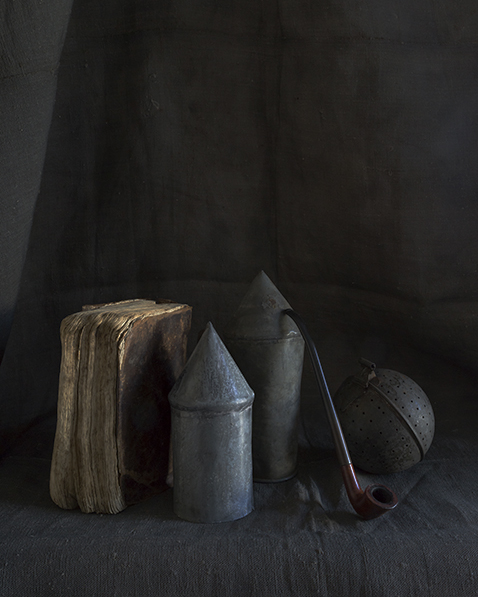
This image is more of an introduction to the new arrivals than a worked out still life. It’s what I do first to see how they stand, their relationship to each other, the way the surface holds the light, the sense of scale they emit in the space they occupy. Surprisingly, some small forms present a sense of scale greater than their real size, and it helps to know that about them for future use. It’s kind of like an audition where the cast of new arrivals struts their stuff for the director. Today the book and the pipe came home with me and we are getting to know each other.

Jan-10 St.L L1000277